Dog Car Restraints: The ONLY 2 That Passed Crash Tests
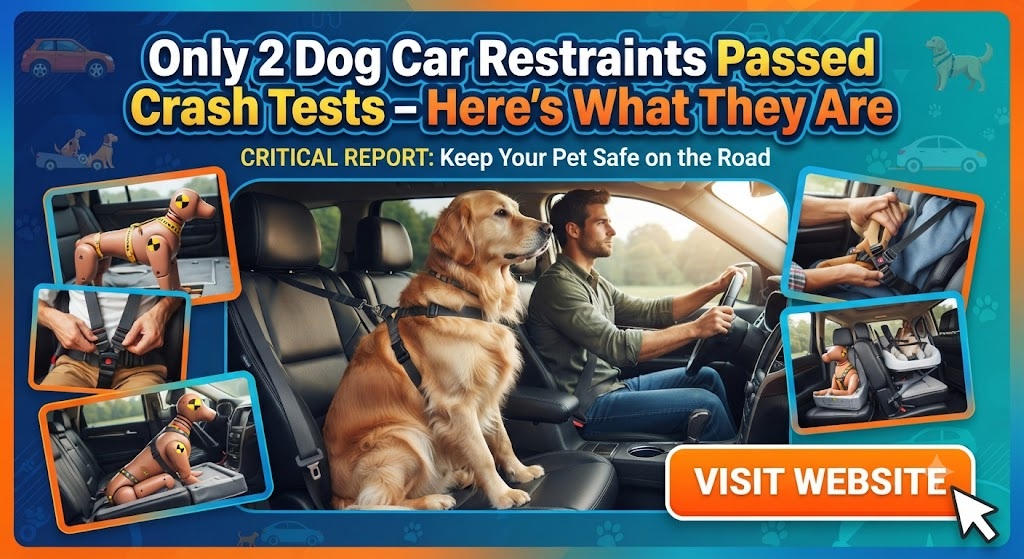
Dog Car Restraints: The ONLY 2 That Actually Passed Crash Tests (Don’t Risk Their Lives)
Every time you load your dog into the car for a trip to the park, the vet, or a cross-country road trip, you are making a critical decision about their survival. Most pet owners believe that a simple harness clipped into a seatbelt is enough to keep their furry best friend safe.
They are wrong.
The pet product industry is largely unregulated. Manufacturers can slap a “crash-tested” label on a harness without ever putting it through a rigorous, independent simulation. In a 35-mph collision, an unrestrained 60-pound dog becomes a 2,700-pound projectile. This doesn’t just threaten the dog’s life; it poses a fatal risk to every human in the vehicle.
When we look at the data provided by the Center for Pet Safety (CPS)—the non-profit “Gold Standard” of pet safety testing—the results are harrowing. Out of dozens of brands claiming safety, only a select few actually prevent the dog from launching off the seat or the harness from snapping like a rubber band.
In this comprehensive guide, we are diving deep into the only two dog car restraints that have consistently passed the most rigorous crash tests on the planet, why the “bestsellers” on Amazon are often death traps, and how you can ensure your dog survives an accident.
The Hard Truth: The Illusion of Pet Safety
Before we name the winners, we must understand the “Wild West” of pet travel gear. Unlike child car seats, which are governed by federal safety standards (like FMVSS 213 in the US), dog car harnesses have no mandatory government oversight.
A company can perform a “static” test—pulling on a harness until it breaks—and call it “crash-tested.” But a static pull is nothing like the dynamic, multi-directional forces of a real car accident.
The Center for Pet Safety was founded to fill this gap. Using the same crash-test dummies and high-speed camera technology used for human automotive safety, they revolutionized how we view pet travel. Their testing criteria are simple but brutal:
- The harness must remain intact.
- The dog (dummy) must remain on the seat.
- The hardware (buckles/clips) must not fail.
When CPS first began testing, the failure rate was nearly 100%. Even today, only two specific models have earned the coveted Five-Star Crash Test Rating.
1. The Sleepypod Clickit Terrain: The Heavy-Duty Champion
The Sleepypod Clickit Terrain is widely considered the safest dog car harness ever manufactured. It is the result of years of engineering and iterative testing. If you have a medium to large dog, this is the gold standard.
Why It Passed
The Clickit Terrain uses a unique three-point contact system. Most harnesses only attach at one point (the back), which allows the dog’s lower body to rotate and launch forward. The Terrain secures the dog’s torso and reduces forward excursion (how far the dog moves forward) significantly.
Key Features:
- Three-Point Design: It mimics the logic of a human three-point seatbelt, securing the dog from both sides and the top.
- Shock-Absorbing Webbing: The materials are designed to stretch slightly to absorb the “G-forces” of an impact, preventing internal organ damage to the dog.
- Ballistic Nylon: The outer shell is made from high-grade ballistic nylon, which is resistant to tearing even under extreme tension.
- Versatility: Unlike many safety-first products, it doubles as a high-quality walking harness with D-rings for a leash.
The Crash Test Performance
In the CPS tests, the Sleepypod Clickit Terrain successfully restrained a 75-pound “Max” dummy (the largest size tested) without the hardware failing. The dummy stayed on the seat, meaning the dog wouldn’t hit the back of the front seat—a primary cause of canine death in accidents.
2. The Sleepypod Clickit Sport: The Lightweight Contender
For many dog owners, the Clickit Terrain is too bulky for everyday use. That’s where its sibling, the Sleepypod Clickit Sport, comes in. It is the only other harness to maintain a consistent Five-Star rating while offering a more streamlined, user-friendly design.
Why It Passed
The Clickit Sport utilizes a patented “Infinity Loop” design. Instead of relying on a single buckle that could be a point of failure, the Infinity Loop distributes the force of a crash across the entire harness. This eliminates the need for heavy metal hardware while maintaining incredible strength.
Key Features:
- Ease of Use: It is significantly easier to put on and take off than the Terrain model. This makes it the preferred choice for short trips to the park.
- Lightweight Construction: It uses energy-absorbing padding that doesn’t add bulk, making it comfortable for the dog to wear for long durations.
- Double-D Ring: For walking, it provides secure attachment points that won’t strain the car-safety components.
- Certified Safety: Like its big brother, it passed the CPS 2730 standard, which is the most rigorous standard in the industry.
The Crash Test Performance
The Sport excelled in the “small” and “medium” dog categories. While it is rated for larger dogs, many owners of giant breeds prefer the Terrain for the extra padding. However, in terms of sheer physics, the Sport’s ability to dissipate energy is world-class.
Honorable Mention: The Saker Canyon
While the Sleepypod duo has held the crown for years, a new challenger has emerged that recently cleared the CPS hurdles: The Saker Canyon.
The Saker Canyon is gaining popularity because it addresses a major complaint with the Sleepypod models: adjustability. While Sleepypods are incredibly safe, they can be difficult to fit on dogs with “non-standard” body shapes (like Greyhounds or Bulldogs). The Saker Canyon offers more adjustment points while maintaining the structural integrity required to pass a 30-mph sled test.
The Danger of Seatbelt Tethers and “Extenders”
If you go to a pet store, you will see “tethers”—short straps that clip into the car’s seatbelt buckle and then clip onto your dog’s harness.
Avoid these at all costs.
Here is why tethers are dangerous:
- The “Guillotine” Effect: Most tethers are designed to clip onto a standard walking harness. In a crash, the harness often fails at the D-ring, or the tether itself snaps.
- Long Excursion: Tethers allow the dog too much movement. If the tether is 12 inches long, and the dog is 24 inches long, the dog can be thrown 3 feet forward. This means they will hit the dashboard, the windshield, or the back of your head.
- Spinal Injury: Because most tethers attach to the back of a harness, the sudden stop causes the dog’s body to whip around the attachment point, often snapping the spine or neck.
The only safe way to secure a dog is with a crash-tested harness that the seatbelt slides directly through, or a crash-tested crate.
The Physics of a Crash: Why Your Dog Needs More Than a Leash
To understand why only two harnesses passed, we have to look at the physics. When a car stops abruptly, everything inside continues to move at the original speed.
The Weight Multiplier
The force of impact is calculated as Mass x Acceleration.
- A 10-lb Chihuahua at 30 mph exerts 300 lbs of force.
- A 30-lb Beagle at 30 mph exerts 900 lbs of force.
- A 75-lb Lab at 30 mph exerts 2,250 lbs of force.
Most plastic buckles found on standard harnesses are rated for “pull force” of maybe 200–300 lbs. In a crash, those buckles shatter instantly. Once the buckle shatters, your dog is no longer restrained. They become a projectile that can kill the driver or passengers upon impact.
The “Sled Test” Explained
The Center for Pet Safety uses a “Sled Test.” They put the harness on a weighted dog dummy, place it on a seat that mimics a real car interior, and propel it into a wall.
- Observation: They look for “hardware deformation.” Did the metal D-ring turn into an oval? Did the webbing fray?
- Rotation: Did the dog stay seated, or did it flip over the seat?
- Internal Impact: If the harness is too thin, it acts like a “cheese slicer,” cutting into the dog’s chest and causing fatal internal bleeding.
How to Properly Fit a Crash-Tested Harness
Buying the right harness is only half the battle. If it isn’t fitted correctly, it won’t work.
1. The “Two Finger” Rule
The harness should be snug. You should be able to fit two fingers (and no more) between the harness and your dog’s body. If it’s too loose, the dog will “slide” inside the harness during a crash, leading to friction burns and bruising.
2. Positioning the Chest Plate
The chest plate should sit squarely on the dog’s sternum (the breastbone). It should never be high enough to press against the windpipe or low enough to interfere with the front legs’ movement.
3. Connection to the Seatbelt
For the Sleepypod Clickit Sport and Terrain, you do not use a separate tether. You pull the car’s actual seatbelt through the loops on the back of the harness. This uses the car’s existing safety technology (the seatbelt pretensioners) to keep your dog safe.
Why Aren’t “Big Brands” Passing?
You might be wondering why famous brands like Kong, Kurgo, or Ruffwear aren’t always on the top of the CPS list.
- Kurgo: Some Kurgo harnesses (like the Impact and Tru-Fit) have performed well in independent tests and are considered “safe” by many, but they have occasionally struggled with “excursion” limits in the most recent CPS testing rounds.
- Ruffwear: While their Load Up harness is designed for car travel and built with high-quality materials, its performance in the specific CPS sled test hasn’t reached the “Five-Star” status of the Sleepypod.
- The Problem with Amazon Best-Sellers: Most “car harnesses” on Amazon are simply walking harnesses with a cheap seatbelt clip included. They provide a false sense of security. They might keep your dog from jumping into the front seat while you’re driving, but they will do absolutely nothing in a collision.
Training Your Dog to Use a Car Restraint
Many dogs hate being restrained in the car, especially if they are used to pacing in the backseat or sticking their head out the window.
- Start Indoors: Let your dog wear the harness around the house. Give them treats and praise so they associate the harness with a positive experience.
- Short “Parked” Sessions: Put the dog in the car, harness them up, and sit with them for 5 minutes without driving. Reward them for staying calm.
- The “Drive-In” Technique: Drive to a nearby location (less than 5 minutes away) that your dog loves, like a park or a pet store. This teaches them that the restraint leads to a fun destination.
- Increase Duration Gradually: Slowly increase the length of the car rides.
Note: Never leave a dog alone in a car while harnessed. If they get tangled or the car heats up, they could be in grave danger.
Is a Crate Better Than a Harness?
If you have a very large dog or a vehicle with a large cargo area (like an SUV or Van), a crash-tested crate is actually safer than a harness.
The Center for Pet Safety has also tested crates. The Gunner Kennels G1 is the only crate to receive a Five-Star rating. It is a double-walled, rotomolded plastic fortress.
Why a crate is sometimes better:
- Protection from Debris: In a rollover or side-impact crash, a harness keeps the dog on the seat, but a crate protects them from shattered glass and collapsing car parts.
- Anxiety Reduction: Many dogs feel safer in a “den” environment.
- Containment After a Crash: One of the biggest risks after an accident is a panicked dog jumping out of a broken window and running into traffic. A crate keeps them contained until emergency responders arrive.
However, for most sedan owners or those who don’t have space for a massive heavy-duty crate, the Sleepypod harnesses remain the best option.
Common Mistakes to Avoid
Using a Collar
Never attach a car restraint to a dog’s collar. In even a minor fender-bender, the force will result in a broken neck or decapitation. Car restraints must always be chest-style harnesses.
The Front Seat
Never place your dog in the front passenger seat, even if they are harnessed. Airbags are designed for humans. An airbag deploying at 200 mph can kill a dog instantly, even if the harness holds. The backseat is the only safe place for a pet.
Using the “Crumple Zone”
The very back of an SUV (the cargo area) is often a “crumple zone.” This area is designed to collapse to protect the human passengers. If your dog is harnessed in the far back, they are in the most dangerous part of the vehicle. If you use the cargo area, you must use a crash-tested crate bolted to the floor.
Financial and Legal Implications
Beyond the emotional devastation of losing a pet, there are practical reasons to use a crash-tested restraint.
- Distracted Driving Laws: In many states and countries, an unrestrained dog is considered a “driver distraction.” You can be ticketed, and if an accident occurs, you may be found at fault.
- Insurance Denials: Some insurance companies are beginning to deny claims or reduce payouts if they find that an unrestrained pet contributed to the accident or caused additional injuries to the passengers.
- Vet Bills: The cost of a $100 crash-tested harness is nothing compared to a $5,000 emergency surgery for a dog that was thrown against a dashboard.
Frequently Asked Questions (FAQ)
Are there any crash-tested harnesses for small dogs?
Yes, the Sleepypod Clickit Sport is excellent for smaller dogs (starting at 18 lbs). For dogs smaller than that, Sleepypod’s carriers (like the Sleepypod Mobile Pet Bed) are actually safer than harnesses. Tiny dogs have fragile ribcages that can be crushed by a harness in a high-impact crash.
How often should I replace a car harness?
You should replace a car harness after any accident, even a minor one. The webbing and stitching are designed to absorb energy by stretching. Once they have been “loaded” in a crash, their structural integrity is compromised, much like a human bike helmet.
Can I use the harness for hiking?
The Sleepypod Clickit Terrain is built for the outdoors. It features MOLLE webbing for attaching packs and is durable enough for rugged trails. However, because it is heavy-duty, it may be too warm for dogs in extreme summer heat.
Does the Center for Pet Safety test for side-impact?
Currently, most CPS testing focuses on frontal impacts, which are the most common and highest-force collisions. However, a harness that prevents “rotation” (like the three-point Sleepypod) offers better protection in side-impacts than a single-point tether.
Final Verdict: Which One Should You Buy?
Choosing between the two winners comes down to your dog’s size and your lifestyle:
- Buy the Sleepypod Clickit Terrain if: You have a large, powerful dog (40–75 lbs), you plan on doing long road trips, or you want a harness that can also function as a rugged outdoor vest. It offers the maximum amount of padding and security.
- Buy the Sleepypod Clickit Sport if: You have a medium-sized dog, you do a lot of quick trips around town, and you want something that is “set it and forget it” easy to use.
The reality is that most pet gear is designed to look good on a shelf, not to save a life. By choosing one of the only two harnesses that have actually survived the laboratory, you aren’t just buying a product—you’re buying an insurance policy for your dog’s life.
Don’t wait for a “near miss” to realize your current setup isn’t enough. Upgrade to a crash-tested harness today. Your dog would do the same for you.